Final Paper
Full project paper explaining Bloom’s theoretical background, ECD framework, competency model, evidence model, task model, assembly model, and validation study plan.Task Model Document
Design document showing the game task prototypes, presentation materials, difficulty rubrics, evidence rubrics, and log data variables.Assembly Model
Q-matrix document showing how Bloom connects task observables to executive functioning competencies and organizes assessment evidence across game levels.Game Tasks
Visual puzzle concepts including card matching, text entry, freeform drawing, juggling, and dial adjustment tasks.Evidence and Difficulty Rubrics
Rubrics connecting player performance to executive functioning competencies such as visual-spatial working memory, verbal working memory, inhibition, task shifting, and alternative strategies.
Bloom
Web-based puzzle game for improving executive functioning skills.
About the project
This project was developed as a web-based educational game focused on executive functioning skills. Bloom is a single-player puzzle game where players solve different challenges to help restore life to an uninhabitable planet. The game was designed by Wallace Pinto and Andrew Tompkin.
Bloom
Web-based puzzle game for improving executive functioning skills.
About the project
This project was developed as a web-based educational game focused on executive functioning skills. Bloom is a single-player puzzle game where players solve different challenges to help restore life to an uninhabitable planet. The game was designed by Wallace Pinto and Andrew Tompkin.
Game Tasks Preview
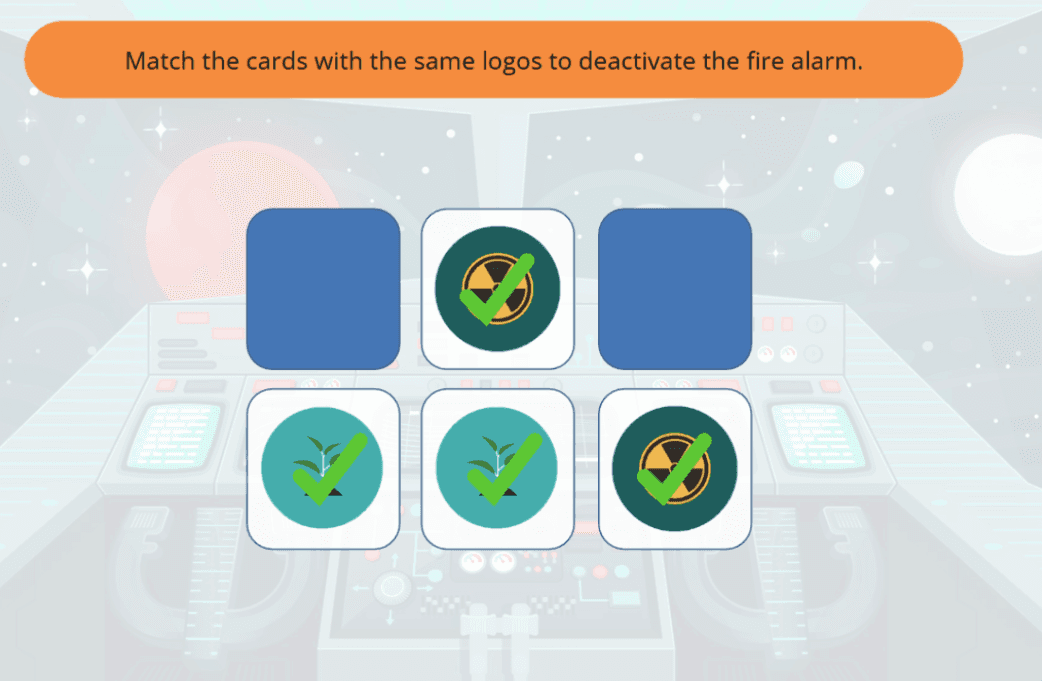
This task is a card matching puzzle designed to assess visual-spatial working memory. Players match cards with the same logos to deactivate the fire alarm. As levels progress, the number of cards increases, requiring players to remember card locations, make accurate matches, and complete the task within the available time.
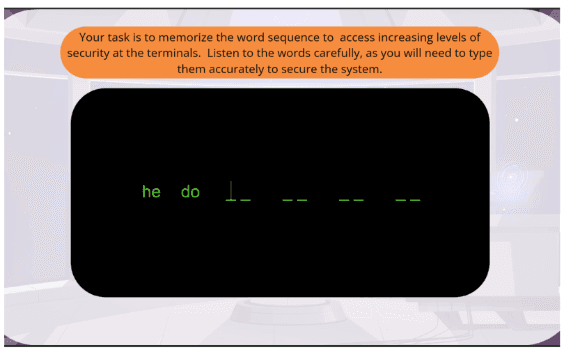
This task is a text entry puzzle designed to assess verbal working memory. Players listen to a sequence of familiar words or alphanumeric characters, memorize the order, and type them accurately into the system. The difficulty increases as the sequence becomes longer, requiring players to hold more information in memory while maintaining accuracy.
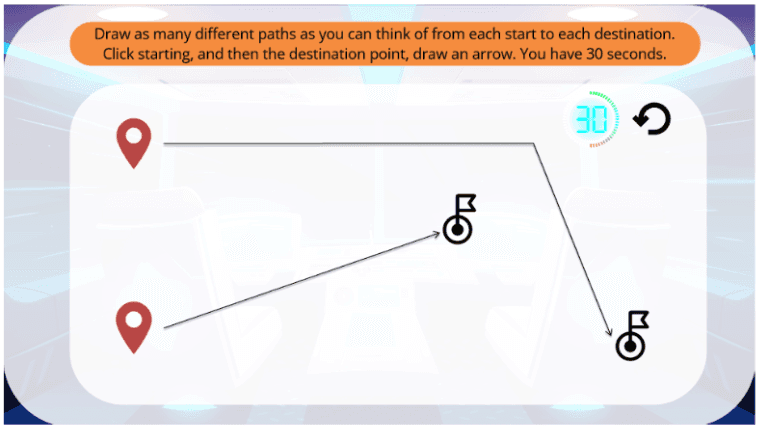
This task is a freeform drawing puzzle designed to assess cognitive flexibility. Players draw paths from each start point to its destination while avoiding obstacles and preventing paths from crossing. The difficulty increases as more obstacles are introduced, requiring players to generate alternative routes, adjust their strategy, and solve the task within a limited time.
About Bloom
Bloom was developed for EME 6638 Stealth Assessment class as a game for improving executive functioning through meaningful puzzle tasks. The game is set on an overpolluted planet where players repair systems, solve challenges, and gradually bring the environment back to life.
The project uses an Evidence-Centered Design framework to connect each game task with specific executive functioning competencies, observable player behaviors, scoring rubrics, and log data. Instead of treating assessment as a separate test, Bloom embeds evidence collection into gameplay through tasks such as card matching, text entry, path drawing, juggling, and dial adjustment.
Bloom was developed for EME 6638 Stealth Assessment class as a game for improving executive functioning through meaningful puzzle tasks. The game is set on an overpolluted planet where players repair systems, solve challenges, and gradually bring the environment back to life.
Bloom was developed for EME 6638 Stealth Assessment class as a game for improving executive functioning through meaningful puzzle tasks. The game is set on an overpolluted planet where players repair systems, solve challenges, and gradually bring the environment back to life.
Materials
Final Paper
Full project paper explaining Bloom’s theoretical background, ECD framework, competency model, evidence model, task model, assembly model, and validation study plan.Task Model Document
Design document showing the game task prototypes, presentation materials, difficulty rubrics, evidence rubrics, and log data variables.Assembly Model
Q-matrix document showing how Bloom connects task observables to executive functioning competencies and organizes assessment evidence across game levels.Game Tasks
Visual puzzle concepts including card matching, text entry, freeform drawing, juggling, and dial adjustment tasks.Evidence and Difficulty Rubrics
Rubrics connecting player performance to executive functioning competencies such as visual-spatial working memory, verbal working memory, inhibition, task shifting, and alternative strategies.
Materials
Final Paper
Full project paper explaining Bloom’s theoretical background, ECD framework, competency model, evidence model, task model, assembly model, and validation study plan.Task Model Document
Design document showing the game task prototypes, presentation materials, difficulty rubrics, evidence rubrics, and log data variables.Assembly Model
Q-matrix document showing how Bloom connects task observables to executive functioning competencies and organizes assessment evidence across game levels.Game Tasks
Visual puzzle concepts including card matching, text entry, freeform drawing, juggling, and dial adjustment tasks.Evidence and Difficulty Rubrics
Rubrics connecting player performance to executive functioning competencies such as visual-spatial working memory, verbal working memory, inhibition, task shifting, and alternative strategies.
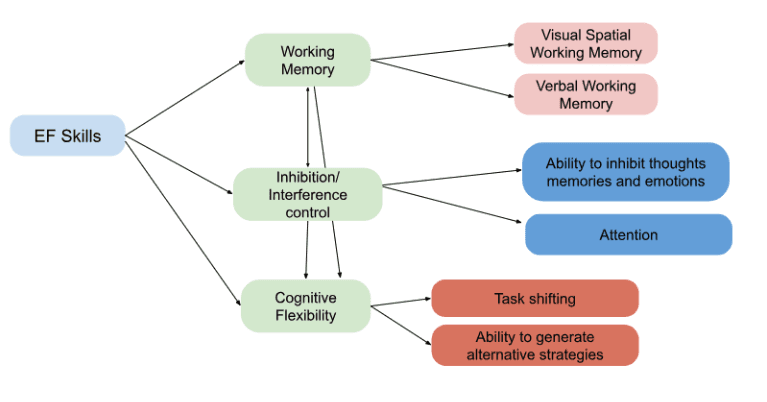
The project uses an Evidence-Centered Design framework to connect each game task with specific executive functioning competencies, observable player behaviors, scoring rubrics, and log data. Instead of treating assessment as a separate test, Bloom embeds evidence collection into gameplay through tasks such as card matching, text entry, path drawing, juggling, and dial adjustment.
Materials
Materials
Final Paper
Full project paper explaining Bloom’s theoretical background, ECD framework, competency model, evidence model, task model, assembly model, and validation study plan.Task Model Document
Design document showing the game task prototypes, presentation materials, difficulty rubrics, evidence rubrics, and log data variables.Assembly Model
Q-matrix document showing how Bloom connects task observables to executive functioning competencies and organizes assessment evidence across game levels.Game Tasks
Visual puzzle concepts including card matching, text entry, freeform drawing, juggling, and dial adjustment tasks.Evidence and Difficulty Rubrics
Rubrics connecting player performance to executive functioning competencies such as visual-spatial working memory, verbal working memory, inhibition, task shifting, and alternative strategies.
Final Paper
Full project paper explaining Bloom’s theoretical background, ECD framework, competency model, evidence model, task model, assembly model, and validation study plan.Task Model Document
Design document showing the game task prototypes, presentation materials, difficulty rubrics, evidence rubrics, and log data variables.Assembly Model
Q-matrix document showing how Bloom connects task observables to executive functioning competencies and organizes assessment evidence across game levels.Game Tasks
Visual puzzle concepts including card matching, text entry, freeform drawing, juggling, and dial adjustment tasks.Evidence and Difficulty Rubrics
Rubrics connecting player performance to executive functioning competencies such as visual-spatial working memory, verbal working memory, inhibition, task shifting, and alternative strategies.
Materials
Game Tasks Preview
This task is a card matching puzzle designed to assess visual-spatial working memory. Players match cards with the same logos to deactivate the fire alarm. As levels progress, the number of cards increases, requiring players to remember card locations, make accurate matches, and complete the task within the available time.
This task is a text entry puzzle designed to assess verbal working memory. Players listen to a sequence of familiar words or alphanumeric characters, memorize the order, and type them accurately into the system. The difficulty increases as the sequence becomes longer, requiring players to hold more information in memory while maintaining accuracy.
This task is a freeform drawing puzzle designed to assess cognitive flexibility. Players draw paths from each start point to its destination while avoiding obstacles and preventing paths from crossing. The difficulty increases as more obstacles are introduced, requiring players to generate alternative routes, adjust their strategy, and solve the task within a limited time.
About Bloom
Bloom was developed for EME 6638 Stealth Assessment class as a game for improving executive functioning through meaningful puzzle tasks. The game is set on an overpolluted planet where players repair systems, solve challenges, and gradually bring the environment back to life.
Bloom was developed for EME 6638 Stealth Assessment class as a game for improving executive functioning through meaningful puzzle tasks. The game is set on an overpolluted planet where players repair systems, solve challenges, and gradually bring the environment back to life.